Harness: What surrounds the model
The model's intelligence is not what makes an AI work. What makes it work is the harness: six decisions a company makes for a digital collaborator, the same ones it makes for a person.
 Rodrigo MedinaFounder & CEO
There is one idea we defend today with more conviction than any other in this business: the model's intelligence is not what makes an artificial intelligence work. What makes it work is everything around it.
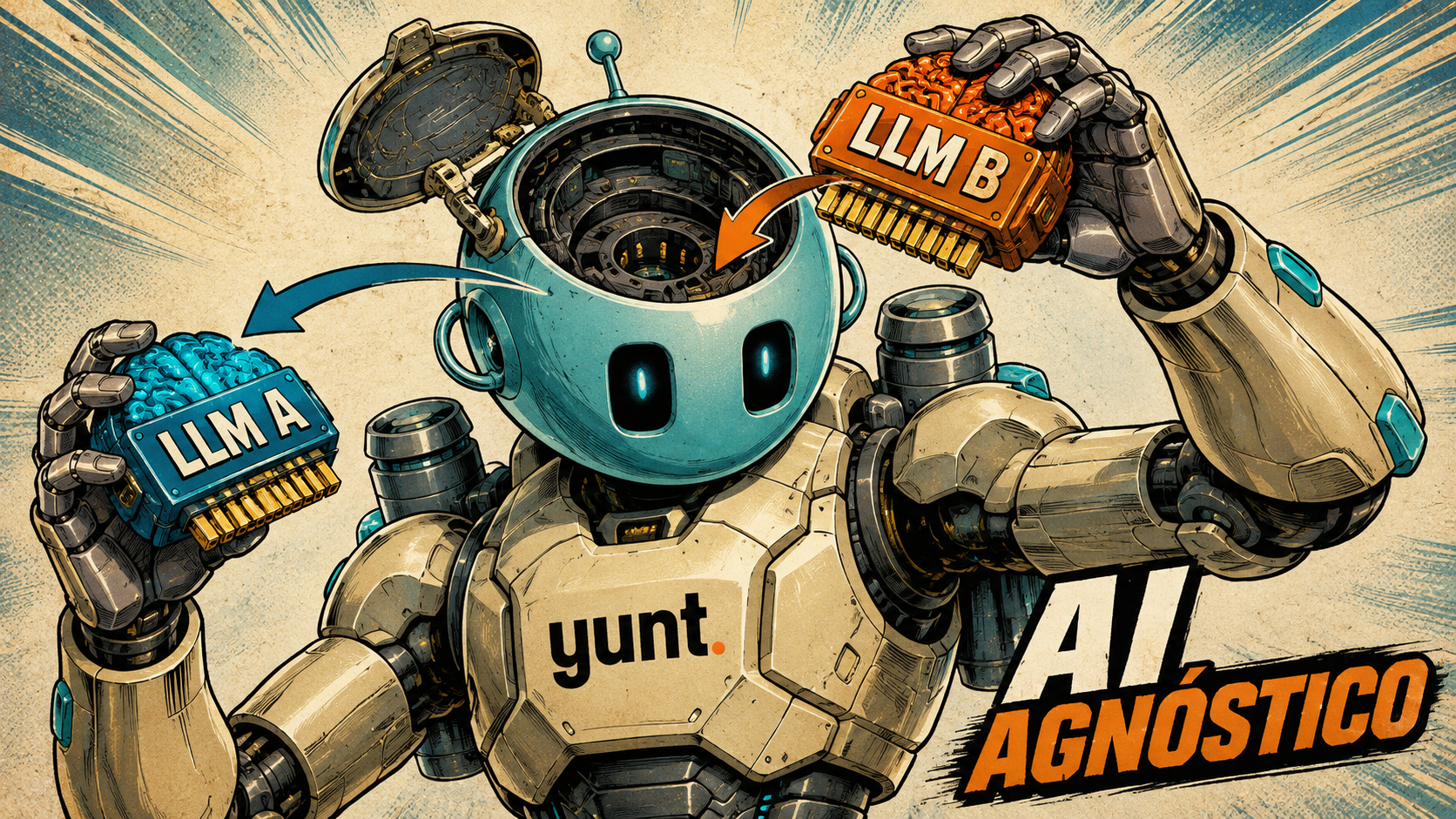
That surrounding layer has a name. It is called a harness: the software infrastructure that surrounds a language model so it can operate as an agent. Addy Osmani, at Google, puts it in one line: a model on its own is not an agent; it becomes one when a harness wraps it.
In Spanish, harness is "arnés". The yoke and straps of a team of oxen, a "yunta". Without the harness, the ox walks wherever it wants. With it, the ox pulls the cart down the road it is given. I know of no better translation for what has to be done with an LLM, and it is no coincidence that our company is called Yunt.
The term settled this year: LangChain in March, Osmani in April, O'Reilly in May, and in August its own Wikipedia entry, with a formula that fits on a napkin: agent equals model plus harness.
A language model is an engine without a body. It takes text in and gives text back. It remembers nothing from yesterday, it cannot open a file, and it does not know whether what it just said is true. That is not a flaw. The mistake is asking it to be something else.
Companies have been building harnesses for a century, only for people. Nobody hires a brilliant professional and leaves them alone. They write a job description, grant access to some systems and not others, have them sign a contract and a confidentiality agreement, give them a manager, a signing limit and a performance review. None of those things makes the person smarter. All of them together make the person trustworthy. A company does not trust a person's talent; it trusts the system around that talent.
The same holds for a model. The harness is that same system, written for a digital collaborator, and it comes down to six decisions: what it can see, what it can do, what it is forbidden to do, what it remembers, who reviews its work, and what gets recorded. They are the same decisions Human Resources makes for every person who joins.
At Yunt we make them like this.
What it can see is its role, in five short files that belong to the client: what anyone in its profession knows, what this position does in this company, how it speaks, who it works with, and what it never does. It reads nothing beyond that.
What it can do is a closed list of named tools: read a contract, calculate a deadline, request a document, escalate to a person. Each one returns a receipt of what it read and where. Outside that list, no action is possible.
What it is forbidden to do is written in the manual and also in code, so it does not depend on the model understanding it: what it does not sign, what it does not promise, and what has to pass through a person before it goes out. What it remembers is not the model's memory, which is wiped when the conversation closes, but a folder per case that the client can open whenever they want.
Who reviews is a manager with a name, and before that there is an exam, like the probation period of any hire: real cases we already know the outcome of, and a trap case with a missing piece of data where it has to ask instead of inventing. Every correction from the manager becomes a written rule and a new case.
What gets recorded is the glassbox: every claim is checked against the log of what it did. If it says it read a clause, the receipt exists. If it does not, the claim is flagged in red and does not go out.
With those six decisions made, the model is a part that can be swapped with one line. The best models in the world last about a quarter today. A company cannot rebuild the way it works every quarter, but it can change engines as often as it likes if it owns the car.
That is why, when people tell me Claude or Cowork already does all this, I do not argue. The engine is the same. What no subscription includes is your company's harness: your process, your rules in code, your manager approving, your record. That part has to be built, and it has to be yours. It is the only piece of all this that cannot be rented.
Sources
LangChain, The Anatomy of an Agent Harness (March 2026)
Addy Osmani, Agent Harness Engineering (April 2026)
O'Reilly Radar, Agent Harness Engineering (May 2026)
Wikipedia, Agent harness (August 2026)