Digital Collaborators
The best of every AI, tailored to your company.
A role on your org chart, performed by AI. It works inside your team, with your processes and in your systems, with a boss and a record.
The problem it solves
Your team lives between platforms.
We know what it's like: your team with Excel, the ERP, the CRM and ten more windows open, answering customer emails, coordinating in WhatsApp groups, jumping into meetings. And unable to deliver what really matters for your business to grow.
Every system solved its own lane. None solved the space between the lanes. That is where the expensive work lives: open, classify, copy, upload, chase, notify.
In the end, a person orchestrates the platforms. For now, they are the only one with real-time context of what happens inside the company and outside it. When we say “AI is going to take our jobs”, this is what we mean: the work that goes away is moving data from one window to another. The work that stays is deciding.
What it is
A role, not a software.
We digitize the role, not the process. We sit down with the person who does that job best and write down what they know, what they do, what they would never do and when they would ask for help. That sheet is the role manual, and it is yours.
A digital collaborator is a role on your org chart performed by artificial intelligence: software that combines different AI models and processes to do that role's tasks inside your organization. With a role manual and defined functions. It lives among your systems. Everything it does is auditable.
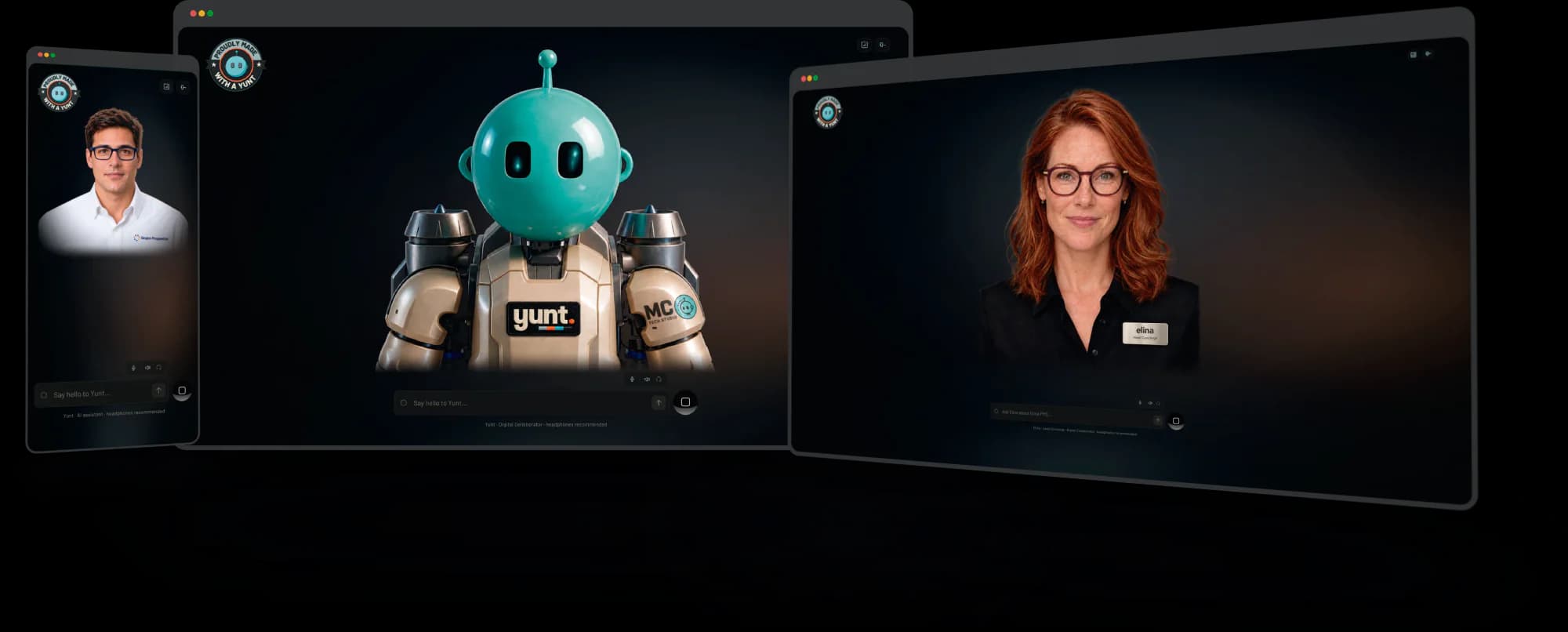
A Yunt wears your company's jersey, not everyone's.
The five conditions
Five conditions to earn the name.
If one is missing, it's software.
Why it isn't generic AI
You didn't build your company to hand it over to a generic AI.
Claude, ChatGPT or Grok answer what you ask them. They are made for millions of users, not for your company: they don't work under your rules, they don't live in your systems, they answer to no one and no one answers when they fail.
AI models are the brain. Yunt is the body: the agents that are its hands in your systems, the role manual, the boss who signs, the record of everything. Each role uses the model that performs best for its job; if a better one comes out, we switch it without your company noticing.
It has agents inside
It's not an agent. It has agents.
An agent does one task: it reads an email, classifies an invoice, queries the ERP, drafts a reply. It is brilliant at that task and knows nothing about your company. It answers when you talk to it and it has no boss.
A digital collaborator is the role that directs those agents. Its brain, the AI models, decides which agent goes to each task, with which data and in what order, following the role manual. One agent to read the inbox, another to classify, another to query the system, another to write. They all work for the same role, under the same rules, and everything they do ends up in the same record.
Every digital collaborator has agents inside. No agent, on its own, is a collaborator.
An invoice reaches the purchasing inbox
The role: Purchasing Yunt
Its brain, the AI models, decides which agent does each step, following the role manual.
01 · Reader agent
Reads the email and opens the invoice.
02 · Classifier agent
Classifies it against your chart of accounts.
03 · Systems agent
Queries the ERP: is there a purchase order?
04 · Writer agent
Writes the reply to the supplier.
Every step goes into the record, with its reason
Its boss signs
What matters goes through a person.
Invoice booked and supplier answered
An agent is not a role configured differently: it is one of the role's hands.
The timeline
First came chat. Then the agent. Now the role.
2023
Chat
It answers what you ask. You do the work.
2025
Agent
It does tasks. It doesn't know how they are done in your company.
Now the road splits in two
For companies · Now

Digital collaborators
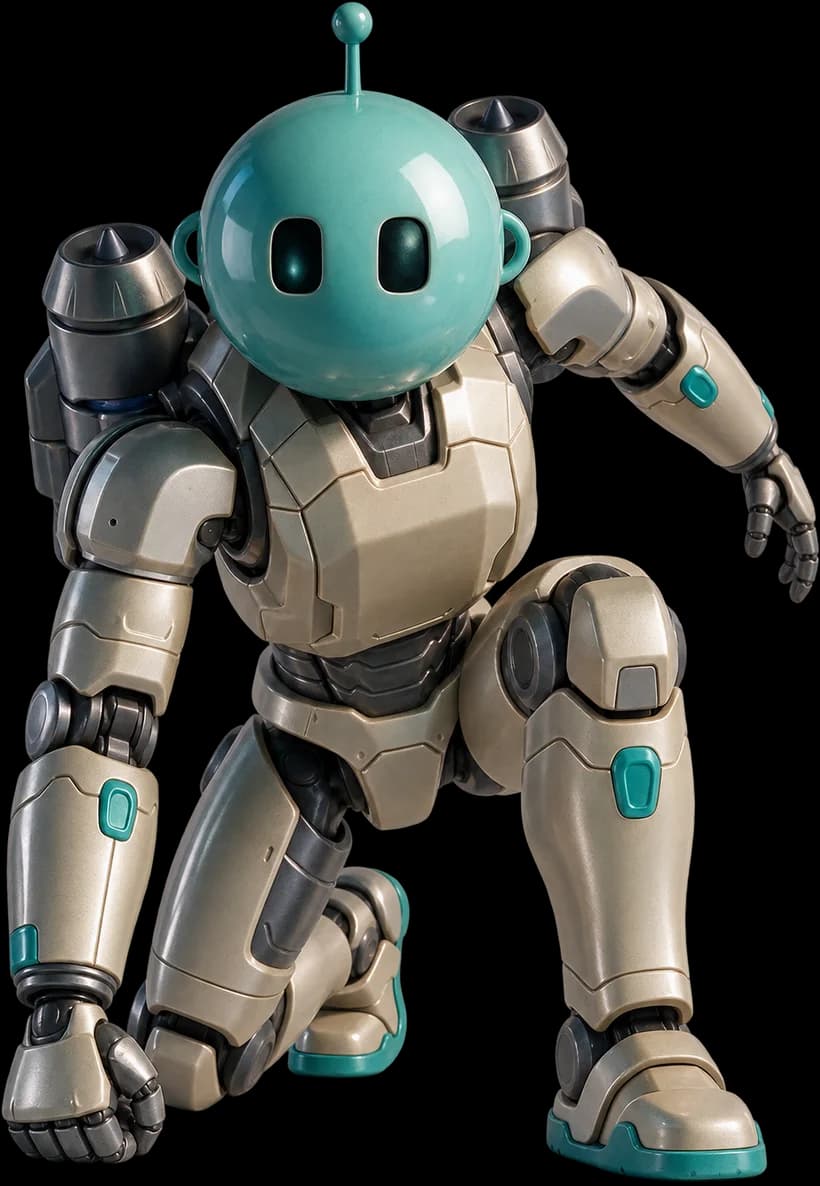
Yunt
A role on your org chart, with a manual, a boss and a record. It lives in your systems.
Next
Robot
It will have a body. And it will arrive at your company with the role manual we write today.
 Optimus
Tesla G1
G1
Unitree H2
H2
Unitree
For people
Personal assistants

Grok Bot
xAI

Muse
Meta · Jolly
They help you with your own tasks. They don't hold a role in your company: no role manual, no boss, no auditable record.
A digital collaborator is the generation of AI before the robot: it already has a role, it doesn't have a body yet.
The harness
What surrounds the model.
The model's intelligence is not what makes an AI work. What makes it work is everything around it. That is called a harness: the yoke and straps of a team of oxen (a yunta, in Spanish). Without a harness, the ox walks wherever it wants; with one, it pulls the cart along the path it's given. That's why we're called Yunt.
Companies have spent a century building harnesses, only for people: nobody is hired and left alone. They get a written role, access to some systems and not others, a boss, a signing limit and a review. None of that makes them smarter. All of it together makes them reliable.
A digital collaborator's harness is those same six decisions, written for it:
With those six decisions made, the model is a part you swap with one line. What doesn't come with any subscription is your company's harness. That one is yours.
The file structure
A digital collaborator is a folder.
Everything it is and everything it does lives in text files that can be opened, read and versioned. Nothing is hidden in someone else's database. A role's folder always has the same parts:
The manual, the identity and the record belong to your company. If tomorrow you change AI model, or provider, the folder is the same.
Where it lives
In the systems you already have.
It works inside your email, your ERP, your spreadsheet and your WhatsApp, without changing how your company works. Your data and your processes live in your infrastructure, under your rules. It reads and writes in your systems with the access you give it, like anyone on your team.
How it communicates
Through the channels you already use. With whoever it should.
Channels
Like one more colleague in the team's channel.
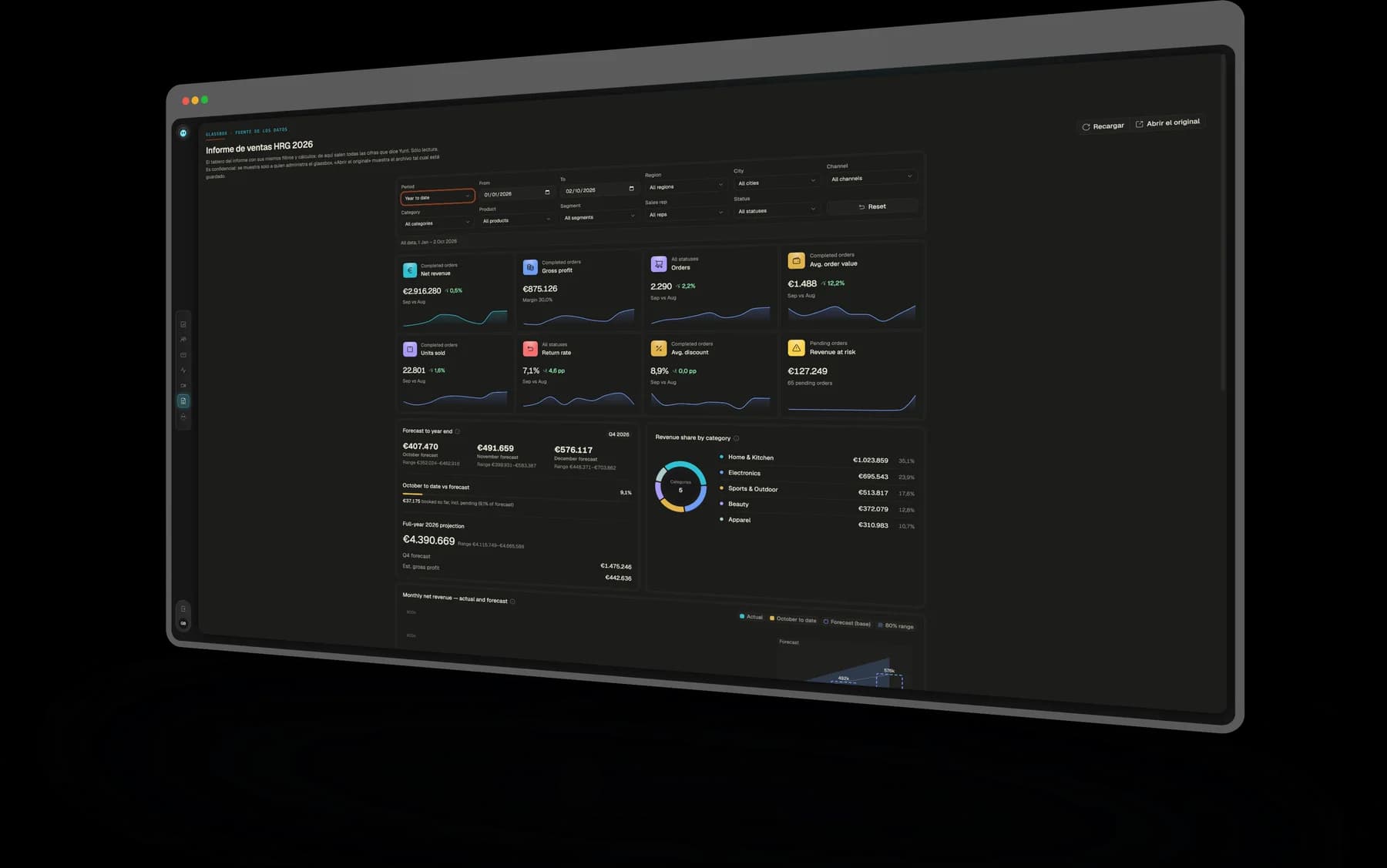
With voice and text, with tables and charts on screen.
From its own inbox.
For people in the field and for the customer who asks.
By voice, in your language and with your rules.
Facing
In your brand's tone and without making things up.
Who asks it and gets the data with its source.
With the morning report, the alert when something goes out of range and the answer in the meeting.
How it's supervised
It has a boss.
It reports to a person in your company. What matters, that person reviews and signs: a payment, a delivery to a third party, a reply to a customer that commits to something. What doesn't matter, it does on its own and writes down. If it can't solve something with its rules, it asks instead of assuming. It never decides for its boss what belongs to its boss.
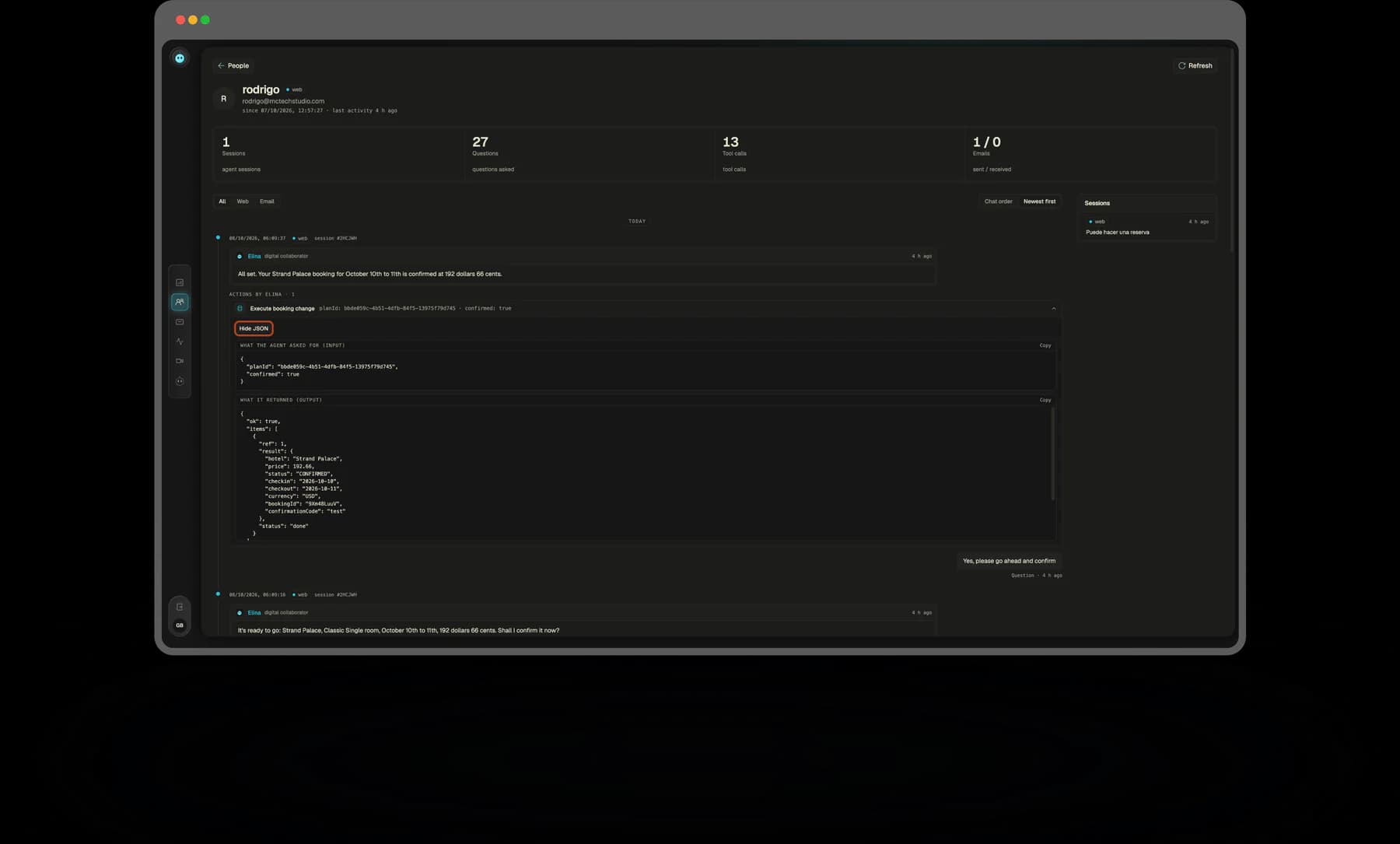
Glassbox
Everything it does is written down, and anyone can review it.
Its boss opens the glassbox and sees the work of the day, the week, the month. A figure that doesn't add up is traced back to the query that produced it. An error isn't hidden: it's reported, corrected and stays in the record. Every month, before the invoice, the collaborator itself delivers the report of what it did, with the numbers from its record.
A role with growing functions
It starts with one function. It grows with your company.
A digital collaborator starts with one function defined in its role sheet and masters it before taking on the next. Then more functions of the same role are added, with the same rules and the same boss. It's a role that grows, not a list of software bought one at a time.
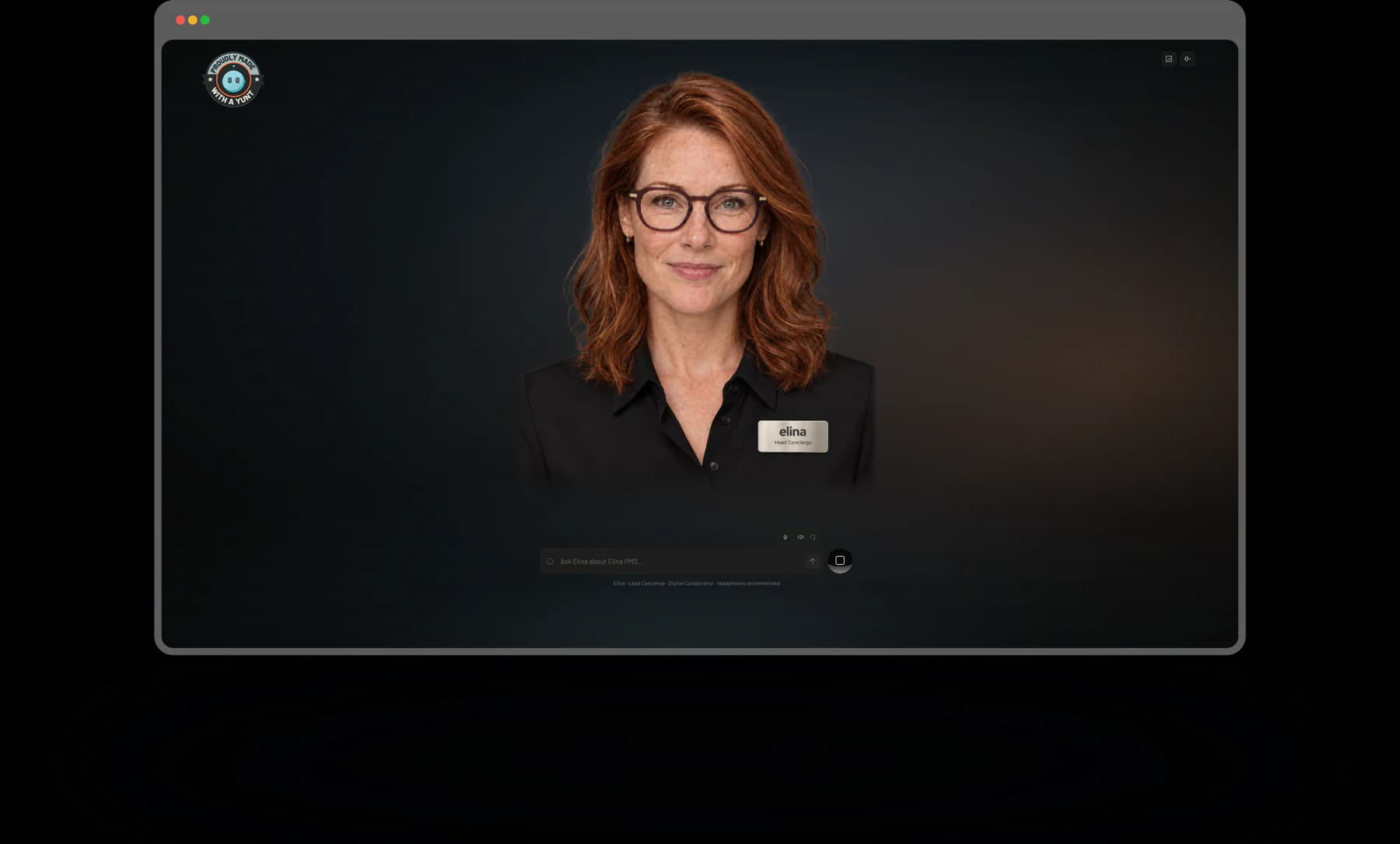
You don't need a generic AI.
Hire a Yunt.
The AI that wears your company's jersey.
Leave your details and our calendar opens so you can pick a time. If you prefer, a member of our team will get in touch with you to arrange it.