
Resilience is no longer enough
Returning to normal stops making sense when that normal is no longer viable. Rather than rebuilding the past, organizations must recognize when to leave it behind.
 Daniel InsulzaAbogado & Consultor Senior
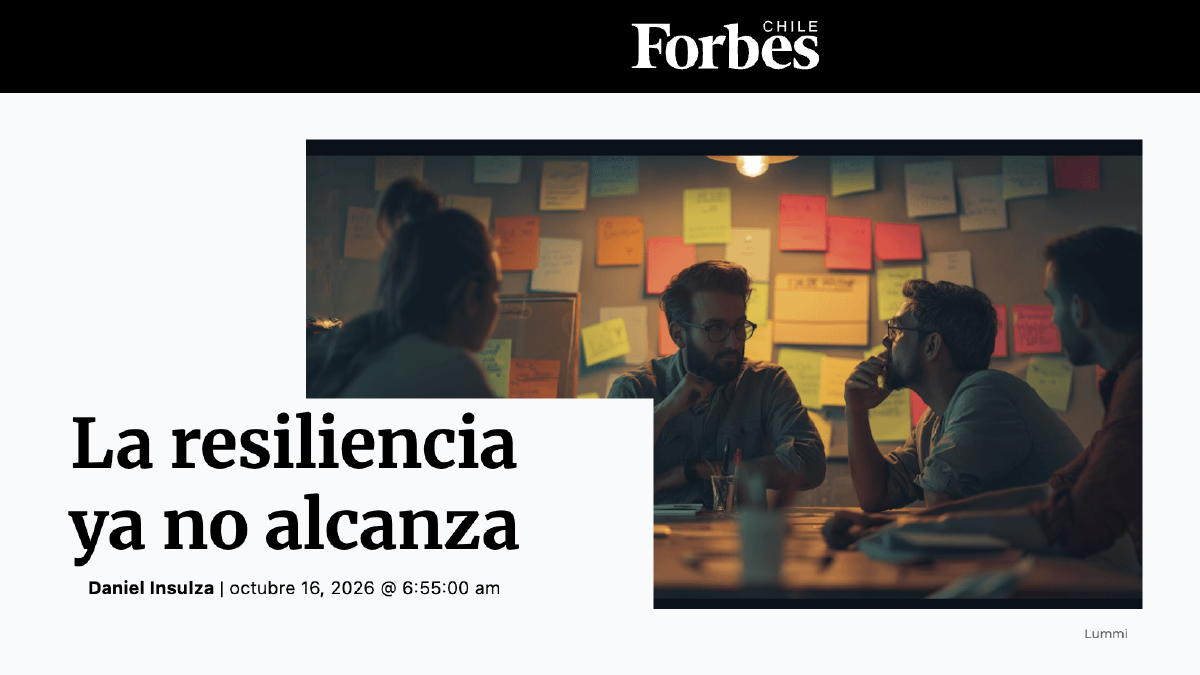
Column by Daniel Insulza, originally published in Spanish in Forbes Chile on October 16, 2026.
For years, resilience was the corporate virtue par excellence: withstand a crisis and restore operations. Today it is not enough. In 2026, companies face simultaneous transformations: AI, geopolitical fragmentation, new rules and pressure on supply chains. The challenge shifts from withstanding to sustaining productivity and impact. (McKinsey 2026)
Recovering can mean returning to the wrong place
Resilience asks: how do we get back to work? Adaptability raises something more uncomfortable: should we do it the same way?
A company can restore its value chain and keep an unviable model, or contain a cyberattack without fixing its causes. Recovering the familiar is reassuring; questioning it takes leadership.
Returning to normal stops making sense when that normal is no longer viable. Rather than rebuilding the past, organizations must recognize when to leave it behind.
Adapting is not improvising
Adapting means observing, evaluating, deciding and learning continuously: reviewing assumptions, reallocating resources and adjusting execution without losing direction, rather than chasing trends. And it is a responsibility of the board and senior management: moving from traditional oversight to strategic, adaptive leadership. (Deloitte 2026; NACD 2026)
But understanding that change is needed does not guarantee arriving in time. Adaptability is changing course; agility is doing it while it still matters. The difference lies in who decides, what gets escalated and how long an approval takes. If every response has to pass through a bureaucratic chain, there is no control, only institutionalized delay.
AI speeds things up; it does not replace judgment
AI helps detect signals and evaluate scenarios, but speeding up pieces of a fragmented system does not guarantee better decisions. Value requires redesigning the operating model. (Scrum.org 2026)
Digital collaborators connect information with decisions, compare scenarios and document what is learned. Their contribution is to broaden the analysis, not to replace judgment. They require clear objectives, authorized access, data protection, traceability and human validation. Human oversight remains central, especially in higher-risk uses. An agile company does not remove control; it builds it into the work. (Morgan Stanley 2026; Connext Global 2026)
The future belongs to those who learn first
The advantage lies in turning information into judgment, judgment into decisions and decisions into timely change.
Adaptability protects relevance; agility protects timing. All three matter, but they are not interchangeable. Withstanding is still necessary, and competing requires learning faster than the environment changes. The question is less whether the company will survive the next disruption than whether it will learn in time to avoid rebuilding its vulnerabilities.
Daniel Insulza is a senior consultant at MC Tech Studio SpA – Yunt.