
This is Yunt, the AI that aims to solve and simplify work in companies
El Dínamo covers how Yunt was born and the five requirements of a digital collaborator: a role, a boss, evidence, audits and accountability.
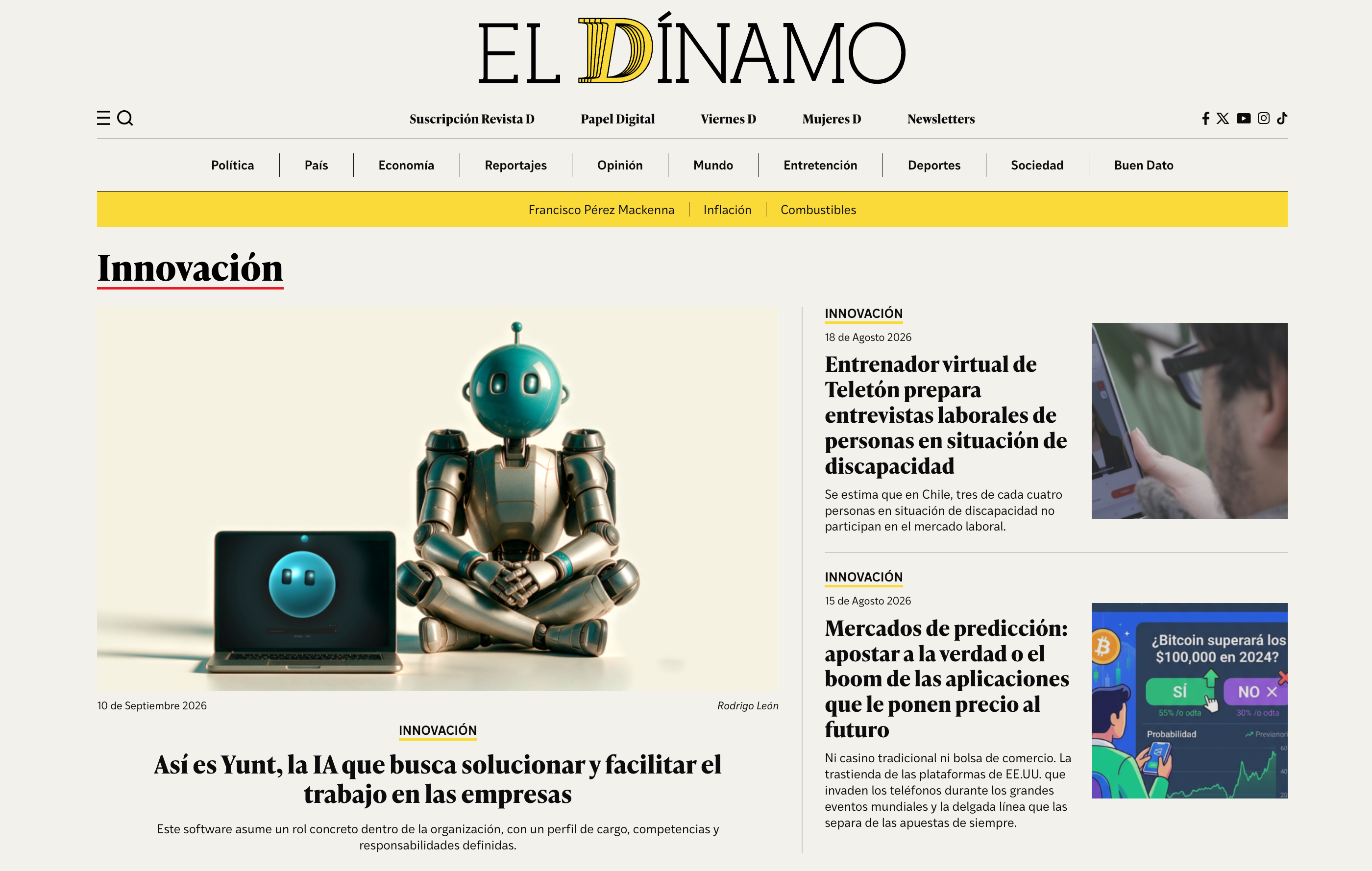
This software takes on a specific role within the organization, with a job profile, competencies and defined responsibilities.
Article published by El Dínamo on September 10, 2026. Written by Rodrigo León. Translated from the Spanish original.
Yunt is the name of the project created by MC Tech Studio to bring Digital Collaborators into mid-sized companies. Its goal is to offer a map in those places where companies are about to approach Artificial Intelligence (AI) with the wrong focus.
The initiative was born just over a year ago, when the firm decided to test a technology based on an AI collaborator working as a Management Assistant: attending meetings, answering emails and checking in over WhatsApp before making any decision, always under the direct supervision of a human boss.
It has no camera and no face, because it is software, but it reported, was held accountable and kept a record of every step, like any other worker.
Its main function was to let the team do more without replacing anyone or adding people. Team members can spend more time directing and signing off on the work, and on the tasks that require their judgment.
All about Yunt
It was this collaborator that helped create Yunt, dedicated to developing and integrating digital collaborators for companies. They are artificial intelligence systems that take on specific roles within the organization, with a job profile, competencies and defined responsibilities. They work under the supervision of a human boss and leave permanent records that allow every step to be reviewed and audited.
MC Tech Studio is a company that has spent more than eight years developing software and working as an external technology management office for organizations in different countries. Its team brings together professionals of six nationalities. That track record of solving technology inside real companies, not on paper, is the technical foundation on which Yunt was built.
“In almost 25 years of professional experience, I have never seen a company org chart with a position called agent,” says Rodrigo Medina, CEO and founder of Yunt. “The term describes the inside of the machine, a definition for engineers. But a manager does not need to know about agentic architecture; they need to answer management questions: who supervises this work? And what happens, and who is accountable, when the software makes a mistake?”
What Yunt does is formalize the concept of the Digital Collaborator. It is not a mere polite euphemism, but a category that sets a high bar for the market through five mandatory requirements:
Having a position: Formally integrated into the functions of the org chart.
Having a boss: A direct human manager responsible for supervision.
Leaving evidence: A transparent, permanent record of every interaction and decision.
Being auditable: The ability to submit its traceability to review processes.
Answering for failures: A clear institutional protocol on who takes responsibility when something goes wrong.
By this standard, the vast majority of the tools sold today as “agents” simply do not qualify.
Most consulting firms approach automation by digitizing processes, flowcharts and concept maps. However, in the real practice of mid-sized and large companies, operations do not run by the manual: they run on the tacit judgment of the person who does the job best, knowledge that is lost every time that professional leaves.
“Trying to sit two people down to agree on the one single process is a dead end,” Medina says.
That is why Yunt stopped digitizing diagrams and moved on to digitizing the role. The best ally for doing so did not come from IT, but from Human Resources.
Yunt explains to its clients the main weakness of this technology: language models (LLMs) can make mistakes and present their answers with total confidence, even when they state facts that do not exist or cite documents that nobody wrote.
“We do not sell magic promises or infallible algorithms,” Medina says. “We deliver the operating structure, the competency-based design and the supervision mechanisms that companies need to bring artificial intelligence in safely. Every step leaves a permanent record that allows the work to be audited. The company's own team stays in charge of directing it and signing off on it.”