
How to extend AI across departments without duplicating the infrastructure
The first digital collaborator enters through one department. The second builds on what is already connected. How to scale AI across departments without mixing permissions or responsibilities.
 El YuntComunicaciones
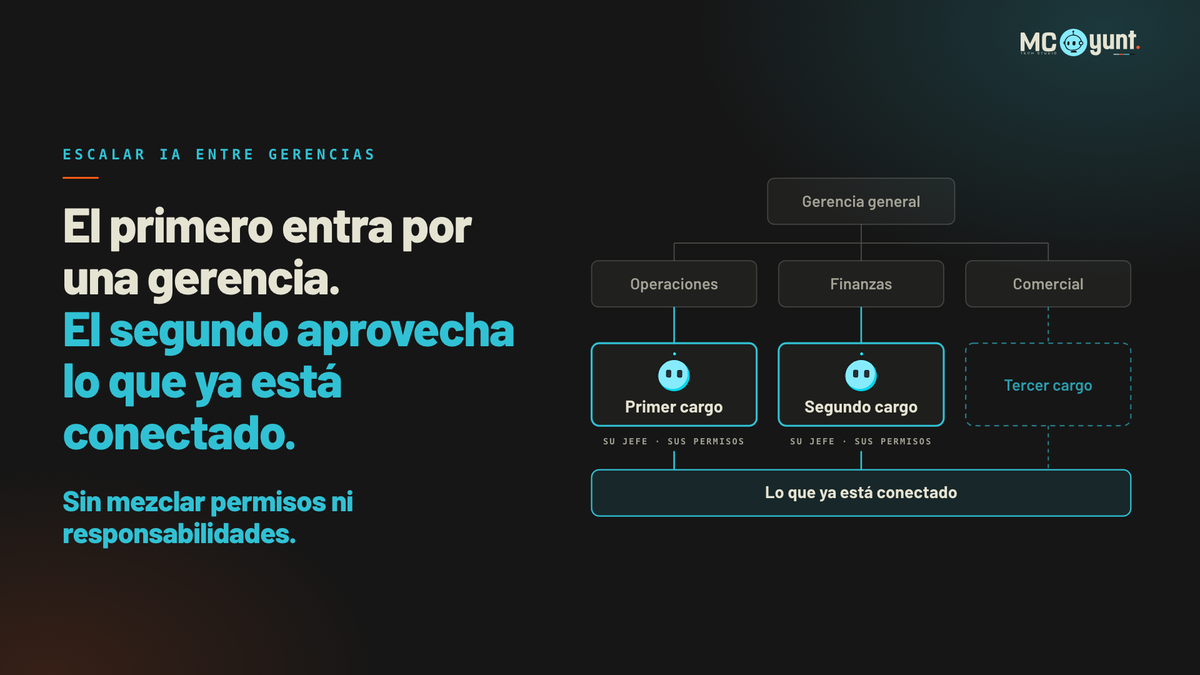
The first digital collaborator almost always enters through a concrete problem in one department: sorting requests, completing background, closing a job that gets stuck. When that role works, the questions start in the other offices: can this be done in finance? And in the field?
Scaling AI across departments in a mid-sized company has a practical advantage: part of the information and the connections already exist. Purchasing and finance work with the same supplier; operations and HR with the same cost-center structure. The opportunity is to reuse that base and keep responsibilities clear.
Share the base, not every access
Shared infrastructure does not mean every collaborator sees everything. The purchasing one needs suppliers and orders, not payroll. The finance one reviews aggregate results without opening anyone's personal records.
Before extending, identify which sources are common, who owns each piece of data and what access the new role needs. Reusing a technical connection does not authorize new uses. Permissions follow the defined work and make it possible to know which person or which collaborator consulted or changed each thing.
The base can be spread across the systems you already have. Sharing infrastructure does not force you to copy the company into a single database or change the ERP.
Separate what is already solved from what changes
In a second implementation there are two groups. The first is available connections, supplier identifiers, the structure of areas and the record. The second is the rules of the new role: deliverables, approval limits, exceptions and manager.
Keeping them apart avoids re-surveying what the company already knows. And it avoids the opposite mistake: assuming a new role is ready because it can already read the data. Having access to an invoice does not teach how to resolve a discrepancy, who to notify or when to stop a process.
At Yunt, reuse within the same company is part of the method. Each new role has its own manual, its own exam with real cases and its own manager. What is common is not rebuilt from scratch, and what is specific is not dropped.
Design the handoffs between roles
Picture a mid-sized company with collaborators in purchasing, finance, operations and HR. Purchasing prepares the request with its backing. Operations confirms receipt. Finance receives the file for review. HR carries on with its own processes and consults only the shared references it needs, such as authorized cost centers.
Each handoff needs a simple definition: what one role delivers, what the next accepts and what happens when information is missing. Without it, individual tasks get faster and the bottleneck between departments stays put.
The same event has to be traceable without losing its origin. If a request changes, the next role recognizes the current version and knows whether an earlier approval still holds. That is solved in the design of the work, not with clarification emails.
Grow by usefulness, not by catalog
The order of adoption depends on where there is useful work to take on. One role opens the way because it has clear owners; another builds on information that is already connected. They do not all have to belong to the same department, and you do not have to hire the whole set at the start.
For each extension, agree the expected result and how it will be reviewed. Shared infrastructure makes the technical part easier. It does not replace the business decision about which role to bring in.
Keep a view of the whole company
Each department reviews its role. The company also needs to know whether the whole improves the operation: fewer returned requests, fewer repeated documents, clearer handoffs.
Separate results per role from shared results. If purchasing stops chasing a document and finance receives the complete file, do not count the same hours twice. And check whether an improvement in one area is pushing work onto another. Each collaborator sends its manager a monthly report with the numbers from its own record; the sum of those reports is the company view.
Frequently asked questions
Does sharing infrastructure reduce each department's independence?
No. Each role keeps its objectives, its manager and its permissions. What is shared is the base that allows working with consistent information.
Do we have to change our current systems?
No. First we review how to access and integrate with the systems the company already uses and what restrictions they have.
Does the second collaborator do the same as the first?
No. It takes on a different role on part of the same infrastructure. Its scope is defined and tested separately, with its own exam.
If your company has several departments with work to solve
We can look at where to start and which base to reuse afterwards.
See how we define a digital collaborator: https://www.yunt.ai/en/digital-collaborator